
How to Think About Crypto as Investment Without the Hype or Hassle

What crypto as investment means
Crypto as investment is a topic that sparks strong feelings. Some see it as the next big thing. Others see it as a gamble. The truth sits somewhere in between, and it depends on what you're trying to do with your money.
Crypto as investment is not one thing. It moves between traditional and alternative categories depending on how you look at it.
Why the alternative-investment label is ambiguous
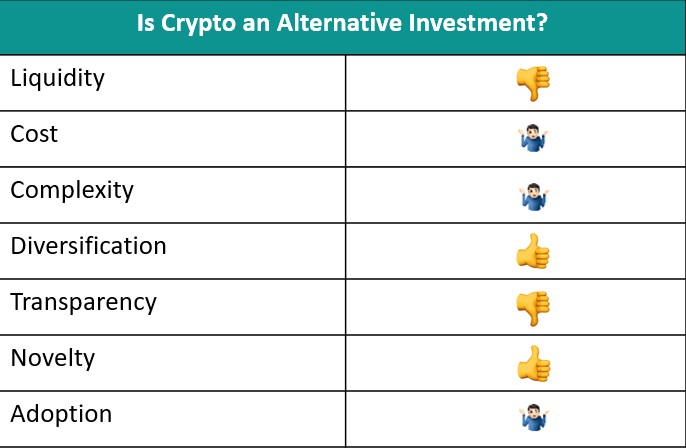
The line between traditional and alternative investments is not always sharp. Crypto has traits from both worlds. It is easy to buy and sell, yet it is technically complex, relatively new, and sits under a developing regulatory framework.
The classification question does not settle whether crypto belongs in a portfolio. It is as much about words as about investment merit. Some traits make crypto look traditional. Others make it look novel and unconventional.
Is crypto a regular asset or an alternative? The answer depends on who you ask and what traits you weigh.
How stocks cryptocurrency compare to traditional assets
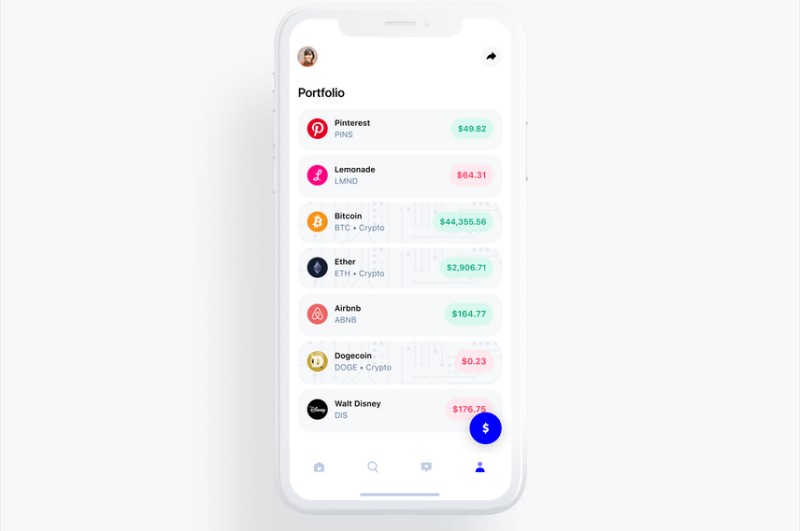
Several developments have pushed crypto closer to mainstream finance. One was the rollout of cryptocurrency trading by Public.com, an app-based brokerage competing with Robinhood. For years, Robinhood had offered crypto access, so Public.com's move came as a surprise.
Public.com has generally been seen as the church to Robinhood's casino, an analogy from Dan Egan of Betterment. Features Robinhood faced criticism for - payment for order flow, options for novice investors, margin trading, gamification - were not present on Public.com at the time.
Commission-free trading apps are used mostly by Millennial and Gen-Z investors. Those generations show comfort mixing crypto with stocks. To some investors, the two feel almost interchangeable. To others, buying a bond ETF seems more unusual than owning Bitcoin or Ether.
Key differences between crypto and traditional assets
- Crypto trades 24/7 while stock markets have set hours
- Crypto transactions can settle almost instantly
- Crypto lacks central authority or government backing
- Crypto has higher volatility than most stocks
Liquidity and access
Crypto is easy to transact on platforms like Coinbase and Gemini. Transactions settle fast, and the market runs around the clock. For most trades, market impact is not a big concern. On liquidity alone, crypto does not look especially alternative.
Cost and fees
Transaction and ownership costs vary. Buying crypto and holding it long-term without frequent trading can be cheap. Other crypto products carry much higher fees. The source specifically noted listed over-the-counter funds and private funds with potentially high fees, along with the warning to examine fees carefully.
If you are thinking about invest in crypto coin , the fee structure matters. A direct purchase and hold strategy can be inexpensive, while funds and platforms may charge much more.
The cost of crypto investing depends heavily on how you do it - holding directly is different from using funds or platforms.
Complexity and understanding
Crypto can get technically complex fast. The counterargument is that people deal with complexity in banking and finance daily while relying on shortcuts and familiar stories to understand them. You do not need to be a cryptography expert to use descriptions like "digital gold" for Bitcoin or "programmable money" for Ether. These stories simplify a more complicated underlying technology.
If you are new to this, investing into crypto for beginners can feel overwhelming at first. The key is to start with simple narratives and build understanding gradually, rather than trying to master the technical layer immediately.
Diversification patterns
Crypto assets have historically followed a path distinct from many conventional asset classes. They have shown large returns and modest to low correlation with other assets. That behavior has shifted in some periods. As crypto became more financialized, it started behaving like other risk assets during macro volatility.
For investors thinking about cryptocurrency investments , diversification matters. A broad crypto index can track the whole market, while others focus on specific segments like layer-1 networks or decentralized finance.
Benefits of crypto index exposure
- Use an index provider's research instead of starting from scratch
- Reduce reliance on picking individual coins
- Add long-term diversification within the crypto sector
- Implement through technology that connects to your workflow
Transparency in crypto
Anyone can download the Bitcoin blockchain, and most blockchains use open-source software letting people inspect the code. Transparency is central to the crypto ethos. Many other alternative assets, especially in private markets, are less transparent.
Novelty factor
Crypto is hard to describe as anything but novel. Stocks and bonds have centuries of data behind them. Bitcoin was described as barely a teenager. Most other crypto assets were toddlers. The relative newness may be the clearest feature making it alternative.
If you are asking what crypto currency is worth investing in , the source does not provide a single answer - it depends on your goals and risk tolerance. The novelty itself is a risk factor worth respecting.
Adoption across generations
The answer to whether crypto is mainstream depends on who you ask. It became a portfolio staple for many Millennial and Gen-Z investors, while parents and grandparents stayed more hesitant. At the same time, Bitcoin's price appeared alongside the Dow, S&P, and Nasdaq on CNBC. Different generations giving different answers shows how loaded the label "alternative" can be.
Whether can you buy crypto on acorns is not the point - the point is that access has never been easier. The real question is whether the platforms you use fit your strategy and risk tolerance.
Institutional interest
Interest in crypto was not limited to younger retail investors. A Fidelity report on digital assets found that 49% of financial advisors had been asked about crypto investing in the previous six months. 26% planned to increase their use or recommendation. 71% of institutional investors expected to buy digital assets.
Crypto developed through a different adoption path from most alternatives. It emerged first among individual users, with wider access following. Historically, alternatives like private equity and hedge funds became institutional first, then opened to individuals. Those stayed beyond the average investor's reach. Crypto moved the opposite direction, leading the source to call it the "Benjamin Button of alternatives."
Crypto went from individuals to institutions, while most alternatives went the other way around.
Financial freedom and community
Sterling Campbell described another part of crypto's appeal as an "infinite game." In this framing, crypto can provide a sense of financial freedom and community while representing a rejection of systems some participants distrust. Its ideals are presented as a potential answer to economic and social problems affecting younger generations.
Stock market cryptocurrency and mainstream visibility
The fact that Bitcoin's price was regularly displayed alongside the Dow, S&P, and Nasdaq on CNBC shows how far crypto has come. To some investors, stock market cryptocurrency feels like a natural extension of portfolio building. To others, it still feels foreign and risky.
The combination of app-based access, institutional products, and extensive media coverage made crypto look like a mainstream alternative investment, which the author described as an apparent oxymoron.
Crypto indexes and passive exposure
The number of crypto assets and research needed to evaluate them can make the market hard for advisors to navigate. Researching, monitoring, and staying current can take serious time and money. Crypto indexes were presented as a way to track a defined methodology without relying only on individual token research.
In a webinar, WisdomTree polled financial advisors. Most advisors and firms had only one person with substantial digital-asset knowledge, and that person spent between zero and one hour per week on digital assets. No one reported spending more than three hours per week.
An advisor can use index information to implement a passive strategy rather than making active bets on individual coins. Passive strategy may provide broader diversification within crypto. Diversification does not eliminate risk in a volatile market, but it may reduce risk from any single cryptocurrency.
Onramp Invest was presented as one platform giving financial professionals access to crypto assets. It connects digital assets with traditional finance, and WisdomTree indexes are available through the Onramp marketplace. Eric Ervin, CEO of Onramp Invest, noted that advisors believe in digital asset benefits but lack time to learn, allocate, and manage crypto investments amounting to less than 5% of client AUM.
Risks to understand before you invest
Crypto assets, including Bitcoin and Ether, are complex, show extreme price volatility, and are described as highly speculative. Investing can mean losing principal. Crypto is often called a currency, but these assets generally operate without central authority or banks. They are not backed by government, have no right of recourse, no insurance protections, are not legal tender, and may have limited usability compared to fiat currencies.
If you are wondering safe cryptocurrency to invest in , the honest answer is that there is no guaranteed safe option in this space. The risks are real, and the protections you have with stocks or bonds do not always apply here.
Governments may restrict use, transfer, exchange, or value of crypto assets. Regulation in the US and other countries continues to develop. Crypto exchanges, liquidity providers, networks, protocols, and other participants may shut down or face security breaches, fraud, insolvency, or manipulation issues. Such problems can reduce prices or block access.
Crypto assets can experience forks and airdrops affecting value or function. Transactions are generally irreversible. An asset may be unrecoverable if sent to a wrong address, wrong amount, or if fraud occurs. A crypto asset may lose popularity or usability. Small holders can affect price. Valuing crypto is difficult, and valuations for the same asset may differ substantially.
Crypto is not for everyone. The risks are real, and the protections you have with stocks or bonds do not always apply here.
Crypto in retirement plans
Some employer retirement plans began offering crypto options a few years before December 2024, available through some plans since 2022. Federal regulators and industry participants raised concerns about crypto in retirement accounts.
Crypto has been characterized as high-risk, high-reward. It hit record prices and also crashed. Bankruptcies and fraud concerns followed. Because of volatility, including crypto in a 401(k) could affect retirement savings.
The Department of Labor oversees employer retirement plans and fiduciaries. Fiduciaries must act in investors' best interests and report annually. The Labor Department does not require detailed data for plans with fewer than 100 participants, leaving some investors out of reported data. Some larger plans aggregate parts of investment data, obscuring crypto holdings.
Under ERISA, fiduciaries must consider potential losses and gains. The Labor Department has cautioned fiduciaries to exercise extreme care before adding crypto to a plan's core lineup. The GAO reported that Labor officials generally had not required fiduciaries to select and monitor every investment option per ERISA standards, including self-directed brokerage windows. Participants investing outside core options may bear primary responsibility for monitoring crypto investments.
Key considerations for crypto in retirement accounts
- Crypto volatility could affect retirement savings amount
- Fiduciaries must act in investors' best interests under ERISA
- Plans with fewer than 100 participants are not fully reported
- Participants outside core options bear more monitoring responsibility
Regulatory landscape
Market structure refers to how assets are classified for regulatory purposes. Different US laws and regulators apply based on activities and asset type. Crypto could be used as an alternative payment system or speculative investment. Because of different uses, there is no single answer on who regulates crypto.
As of September 2025, Congress was considering the second stage of a planned three-part cryptocurrency legislation package. The first was the GENIUS Act, signed by President Trump in July 2025. The Senate was expected to consider a market-structure bill, with a similar version passing the House. The third part involved a House bill on central bank digital currencies.
The stablecoin and market-structure bills would create a new federal framework for crypto. Brad Lipton of the Roosevelt Institute argued the legislation could create major risks if protections were weakened.
How crypto assets have been classified
Courts, regulators, and crypto companies have applied existing law to crypto. Most courts classified most cryptocurrencies as securities. Prominent regulators from both parties agreed some crypto assets, particularly Bitcoin, were commodities rather than securities.
A crypto asset becomes a security when a corporation offers it and cultivates it as an ongoing investment. Bitcoin was described differently because it is not cultivated as an ongoing investment by one company. Some crypto companies accepted applicable rules and began complying. Others spent years trying to avoid security treatment, arguing uncertainty made operations difficult. The Roosevelt Institute disputed that argument, pointing to SEC's prior explanations and offers of additional guidance.
SEC and CFTC enforcement
Security status triggers the SEC's proactive framework of mandatory disclosure, enforcement, and investigations - many provisions dating to the New Deal era after family savings were lost in fraudulent offerings before the Great Depression. For crypto, participating entities include issuers, exchanges, brokers, and digital-wallet platforms.
The CFTC relies more on self-certification and may need to prove wrongdoing before intervening. The source argued the CFTC lacked experience regulating markets where companies raise trillions. Its existing market was largely business-to-business with sophisticated participants. The SEC had a budget and staff between six and eight times larger than CFTC's. Without major resource increases, transferring much of crypto to CFTC could result in little effective regulation.
SEC interpretation and taxonomy
On March 17, 2026, the SEC issued guidance on how federal securities laws apply to crypto assets and related transactions. The March 20 summary was written by Folake Ayoola for the Public Company Advisory Blog.
Historically, the SEC used the Howey test to decide if a crypto arrangement involved an investment contract. The test is flexible but required case-by-case analysis. In absence of a crypto-specific framework, the SEC applied existing law through interpretive guidance and enforcement. The 2026 interpretation created a functional taxonomy grouping crypto assets by designed purpose and practical use.
The guidance established four categories that would not be securities in described circumstances: digital commodities, digital collectibles, digital tools, and stablecoins covered by the GENIUS Act. Digital securities were identified separately as financial instruments covered by securities law but formatted as crypto assets.
The SEC emphasized that an asset's functional category does not determine legal treatment of every transaction. A non-security crypto asset may be offered as part of an investment contract. An asset's status can change over time. The SEC took the position that an investment contract could continue during secondary trading, differing from the Clarity Act framework.
Activities clarified by the interpretation
Mining and staking help validate transactions and maintain blockchain networks. Under the interpretation, these activities generally are not securities transactions. Token wrapping allows non-security crypto assets to be used on different blockchains without being treated as securities. Airdrops distribute tokens for promotion or network development and typically do not involve an "investment of money" under Howey.
The CFTC joined the SEC in issuing the interpretation. Both agencies stated some non-security crypto assets might qualify as commodities under the Commodity Exchange Act. The coordinated guidance aimed to clarify responsibility division. The interpretation did not replace the need for legislation but provided detail on how existing laws apply.
The account cited remarks by SEC Chairman Atkin at the DC Blockchain Summit indicating additional guidance was expected.
How to think about crypto as investment
- Understand the risks - volatility and speculation are real
- Consider your time horizon and risk tolerance
- Examine fees carefully before choosing a platform or fund
- Diversify within crypto if you decide to allocate
- Remember that protections for stocks may not apply to crypto




Comments on “How to Think About Crypto as Investment Without the Hype or Hassle”
No comments yet. Be the first to share your thoughts.